Policy Paper · 27 May 2026
Productivity Parity
A Mandate for Local Government in the AI Era
A Policy Paper from Local Government Accountability (LGAI)
Key Takeaways
- The productivity standard imposed on every taxpayer must apply with equal force to the agencies that tax them.
- There is no constitutional carve-out for bureaucratic inefficiency.
- Local government in 2026 has access to the same productivity tools that have restructured every other significant sector.
- The decision not to use those tools is a decision to extract more taxation than is necessary to provide the same services.
- The 36-month window for orderly adjustment is closing — communities that wait will face emergency cuts later.
Reading time: 18 min
In This Edition
- 2026 AI workforce impact analysis
- New efficiency parity pillar
- Phased adoption roadmap
- July 2026 Update: Gartner prediction now verified by named corporate actuals (Oracle, Amazon/Walmart, Wall Street) with sources; anonymized worked example; refreshed federal + state-CIO data; national framing
Interactive charts and a variable-input model are still in the works. This page is the current published edition; the PDF download is the printable version.
Executive Summary
In every meaningful sector of the American economy outside government, 2025 and 2026 are the years AI productivity stopped being a forecast and became an operating fact. The largest, most profitable corporations on Earth are eliminating the middle-management layers that justified their cost structures for two generations. The federal civilian workforce has contracted by roughly nine percent in ten months. State governments from Utah to Maryland to Virginia to Pennsylvania have launched formal productivity initiatives with quantified results. City governments from Hamilton, Ontario to Austin, Texas to Winnipeg, Manitoba have deployed AI in permitting, financial operations, and citizen services and have published the operational gains.
Almost no county or municipality has done equivalent work.
This paper makes the case for what we call the Productivity Parity Standard. The standard is simple: every local government in the United States must, by 2027, complete a documented operational audit identifying where AI-driven productivity gains are available, must commit to deploying them on a defined timeline, and must publish the projected savings alongside the projected service-level outcomes. The standard rests on four premises:
First, the private sector has already moved. The data is no longer anecdotal. Over 1.2 million U.S. job-cut announcements were recorded in 2025 alone — the highest since 2020 and a 58 percent increase over 2024 — with AI cited as the direct cause in over 71,000 of those announcements and restructuring accounting for another 133,000. By PwC's count, 74 percent of AI's economic value is being captured by just 20 percent of organizations. Gartner projects that one in five organizations will eliminate at least half of their middle-management positions by year-end 2026.
Second, the federal government has demonstrated that government-side workforce reduction at scale is operationally achievable. Between January and November 2025, federal civilian employment fell by approximately 271,000 workers, with comparable cuts attributable to AI integration. The Cato Institute described this as “the largest peacetime workforce contraction on record.” The mechanism worked; the dispute is over the scope and the political execution, not the operational feasibility.
Third, leading states have published operational results. Utah's Government Reform, Innovation & Transparency initiative requires every state agency to deliver at least one efficiency project annually, and reports cost, time, and service-quality metrics quarterly. Pennsylvania's deployment of ChatGPT to state staff saved an average of eight hours per worker per week. Maryland documented $800,000 in annual savings from a single cross-agency procurement insight. Virginia's agentic AI pilot is scanning regulations against statute to identify conflicts and redundancies. The National Association of State Chief Information Officers, which surveys state CIOs annually, ranked AI as the number-one priority for 2026 — the first time in thirteen years that anything other than cybersecurity has held that position.
Fourth, the operational case studies at the municipal level are no longer theoretical. Hamilton, Ontario, reports a sixty-percent reduction in permit processing time. Austin, Texas, reduced site plan review from one week to three minutes. Winnipeg projects $730,000 in net present value savings from AI invoice automation. Liverpool reports £1.8 million in annual savings from AI case management. Johnson County, Kansas, reduced mental health documentation time from eighteen to eleven and a half minutes per note, with up to sixty percent documentation reduction at scale. The mechanism is real, the savings are documented, and the implementations have not produced the catastrophic service collapses that local government leadership routinely cites as the reason for inaction.
What remains is whether the local governments that fund themselves out of the same property-tax base as the rest of us will catch up before the property-tax base contracts and forces emergency adjustments. That is the lag-lead trap, examined in detail in LGAI's founding white paper. This paper makes the affirmative case for closing the gap.

Section
The Private-Sector Earthquake — A Recap with Citations
Challenger, Gray & Christmas tracked more than 1.2 million U.S. job-cut announcements in 2025, with AI cited as the explicit cause in 71,825 of them and restructuring accounting for another 133,611. By the end of the first quarter of 2026, an additional 70,000 layoffs were explicitly attributed to AI.
The headline private-sector cuts of 2025 and early 2026 included:
- Amazon: approximately 30,000 cuts across October 2025 and January 2026, with internal communications explicitly citing the elimination of “organizational layers” and the use of AI to handle coordination, reporting, and forecasting.
- Oracle: up to 30,000 in a single-day mass termination in March 2026, tied to a $40 billion AI-datacenter joint venture with SoftBank.
- Intel: 21,000 (approximately twenty percent of the workforce), with $500 million of operating expense reduction in 2025 and an additional $1 billion targeted for 2026.
- Microsoft: approximately 15,000 in 2025, with stated rationale being the reduction of middle management and administrative functions to fund AI and cloud investment.
- Meta: approximately 8,000 in May 2026, targeting nearly twenty percent of the workforce.
- Block (Square): approximately 4,000 in February 2026. Jack Dorsey's public statement was that the cuts were “not driven by financial difficulty, but by the growing capability of AI tools.”
- Coinbase: approximately 700 in May 2026, with the company publicly committing to a maximum of five management layers between CEO and individual contributor.
- Atlassian: 1,600 (ten percent), citing changes required for the “AI era.”
- Cloudflare: 1,100 (approximately twenty percent), with internal AI usage rising 600 percent in the three months preceding the announcement.
- PayPal: approximately 4,760 (twenty percent), with explicit stated rationale of removing “duplication and layers from our organizational structure.”
- Accenture: approximately 11,000 in December 2025, tied to restructuring around AI service delivery.
- Dow Chemical: 4,500 (thirteen percent), with stated rationale of “reengineering how work gets done.”
Two industries deserve specific attention. In the legal sector, Baker McKenzie — the largest law firm in the Am Law 200 by personnel headcount — eliminated between 600 and 1,000 business-services roles in February 2026, citing AI integration as the cause. Clifford Chance and Perkins Coie executed comparable cuts. Across the industry, seventy percent of attorneys report using AI weekly, and major firms have reduced summer associate programs because junior associate work is precisely what AI now performs. In the advertising holding-company sector, WPP officially dismantled its century-old holding-company model in February 2026 with the “Elevate28” plan, targeting £500 million in annual cost savings. Omnicom acquired Interpublic for $13 billion and announced $1.5 billion in cost reductions; Publicis overtook WPP as the largest agency group by revenue on the strength of its earlier data and AI bets.
Gartner's projection is the standard reference point for what these moves cumulatively mean: by year-end 2026, twenty percent of organizations will use AI to flatten their organizational structures, eliminating more than half of current middle-management positions. PwC's 2026 AI Performance Study, surveying 1,217 senior executives across 25 sectors, found that 74 percent of AI's economic value is captured by just 20 percent of organizations — and that the laggards are falling further behind, not catching up.
That projection is no longer hypothetical; the named actions have arrived. Oracle cut 20,000 to 30,000 roles — roughly eighteen percent of its workforce, concentrated in middle management (Forbes). Amazon eliminated 14,000 corporate roles citing AI-enabled leaner structures; middle managers made up 29 percent of all its 2024 layoffs, and Walmart froze its 2.1-million headcount for three years as AI absorbs white-collar work first (People Managing People). Global banks — Citi, JPMorgan, and Goldman Sachs among them — are laying the groundwork to eliminate as many as 200,000 roles over three to five years, concentrated in back- and middle-office oversight (Bloomberg Intelligence). Local governments were told this was coming. The private sector did it while local-government headcount kept rising. The ask in this paper is no longer prophetic; it is remedial.
The relevance of these figures to local government is not analogical. Local government is funded by tax revenue that is generated by the same workforce being restructured in these companies. When the private-sector productivity adjustment produces lower headcounts, lower compensation per role, and lower property-tax-paying populations in some sectors, the property-tax base contracts in step. Local government can either anticipate that adjustment and adjust its own cost structure, or it can refuse to adjust and impose the resulting fiscal pressure on a property-tax-paying public whose own employers have already adjusted. The first path is reform. The second path is the lag-lead trap.
Exhibit 1
Named private-sector AI restructuring, 2025–2026
Each figure is the reduction the employer announced. Local-government headcount, by contrast, held or rose over the same window.
| Employer | Announced reduction |
|---|---|
| Amazon | ~30,000 |
| Oracle | 20,000–30,000 (~18%) |
| Intel | 21,000 (~20%) |
| Microsoft | ~15,000 |
| Accenture | ~11,000 |
| Meta | ~8,000 (~20%) |
| PayPal | ~4,760 (20%) |
| Dow Chemical | 4,500 (13%) |
| Block (Square) | ~4,000 |
| Atlassian | 1,600 (10%) |
| Cloudflare | 1,100 (~20%) |
| Coinbase | ~700 |
Global banks (Citi, JPMorgan, Goldman Sachs) are laying groundwork to eliminate as many as 200,000 roles over three to five years (Bloomberg Intelligence). Source · company disclosures & Challenger, Gray & Christmas job-cut tracking, 2025
Section
The Federal Demonstration
In January 2025, the Trump administration created the Department of Government Efficiency by executive order. The political and legal record of DOGE is contested and is not the subject of this paper. The relevant fact for state and local governments is the operational record of what DOGE actually achieved in workforce reduction.
Between January and November 2025, federal civilian employment fell by approximately 271,000 workers — a nine-percent reduction in less than a year. Approximately 60 percent of that decline occurred in a single month (October 2025), driven by a one-time civil-service buyout offer. The Cato Institute described the contraction as “the largest peacetime workforce contraction on record.” Federal employment in November 2025 stood at levels last seen in 2014. By January 2026 the contraction had deepened past eleven percent — a net decline of roughly 256,000 civilian employees since late 2024, the lowest level in decades (Center on Budget and Policy Priorities). By the end of 2025, the U.S. Office of Personnel Management reported approximately 352,000 federal workers had exited their roles during the calendar year, with over 123,000 of those taking the deferred resignation offer.
Agency-level outcomes were instructive. The U.S. Agency for International Development, which spent over $30 billion in 2024, was folded into the State Department by November 2025. The Department of Education spent approximately $40 billion less in 2025 than in 2024. The Federal Communications Commission's spending tracked at roughly one-third of 2024 levels. The Securities and Exchange Commission and the Federal Trade Commission both ran materially lower. By March 2026, approximately nine percent of the total federal workforce had been eliminated, and the Partnership for Public Service had documented nearly 200,000 federal worker exits since the initiative began.
The federal record is genuinely mixed. DOGE failed to reduce the topline federal deficit; spending rose, not fell, in 2025, and the Senate Subcommittee on Investigations estimated that DOGE generated over $21 billion in offsetting waste even as it claimed savings elsewhere. The Cato Institute estimated that even a ten-percent federal workforce reduction yields only about $40 billion against a $7.6 trillion budget because federal civilian payroll is roughly eight percent of total federal spending. The federal government is, structurally, an entitlement-and-interest-payment machine, and workforce reduction alone cannot fix that.
That structural limitation does not apply to local government. There is no Social Security at the county level. There is no Medicare line item in a city budget. Local government spending is overwhelmingly personnel and personnel-driven contracts — exactly the categories where AI-augmented productivity gains are real and immediate. A nine-percent workforce contraction at the federal level produces marginal savings against the deficit. A nine-percent workforce contraction at the county or municipal level produces dollar-for-dollar property-tax relief, dollar-for-dollar reserve restoration, or dollar-for-dollar service expansion, depending on the choices the governing body makes. The federal record is the proof of operational feasibility. The local opportunity is the proof of fiscal impact.
Section
The State-Level Early Movers
The state-level record is the most useful template for local government, because the political environment, the legal framework, and the operational scale are closer to the county and municipal level than the federal record is.
Utah — GRIT (Government Reform, Innovation & Transparency)
Governor Spencer Cox signed an executive order launching GRIT on May 9, 2025. The program is the most institutionally serious state-level reform currently operating. Every state agency is required to submit at least one efficiency improvement project to the Governor's Office of Planning and Budget annually, to independently launch at least one additional internal project per division, and to participate in the statewide Efficiency and Process Improvement Collaborative. The state's Customer Experience Initiative collects continuous resident feedback via QR codes posted on receipts and in government buildings, focused on the “effort, reliability, satisfaction, and compassion” of state services. Agencies that implement evaluator recommendations can redirect a portion of the savings into staff retention — a structural reward for reform rather than the punishment that reform typically attracts in government. Utah's Director of AI Christian Napier has publicly reported on the state's pilot of Claude Code at state agencies, documenting forty hours of developer time saved over a four-week window. Utah ranks first in fiscal stability in the U.S. News and World Report state rankings; the reform is being executed from a position of fiscal strength, not crisis, which is precisely the position from which reform should be executed.
Florida — Florida DOGE
Governor Ron DeSantis and Chief Financial Officer Blaise Ingoglia launched the Florida Department of Government Efficiency in July 2025 with letters to Broward County and the City of Gainesville requesting financial information, compensation data, contracts, and DEI program records. By October 2025, the Florida DOGE Task Force had visited twelve jurisdictions and sent data requests to all 411 Florida municipalities and all 67 Florida counties. Findings disclosed in the October announcement included: the City of Jacksonville's $75,000 expenditure on a hologram of the mayor at Jacksonville International Airport, a $7.5 million sidewalk project that cost nearly eight times the FDOT average, and $1.9 million in grants to DEI-focused arts groups; the City of Pensacola's $150,000 annual contract with a management company that brings drag shows to a city theater and $300,000 spent on an equity-focused strategic plan; the City of Gainesville's $189,000 salary for a Director of Equity and Inclusion; and the City of Orlando's $460,000 spent since 2020 to count trees as part of the city's “tree inventory.” Florida maintains the lowest ratio of state government workers to population among the fifty states (96 full-time employees per 10,000 residents) and the Fiscal Year 2025–2026 budget marked the second consecutive year of a year-over-year reduction in state spending. The state-level methodology and the citizen-led methodology of LGAI are complementary, not redundant, and LGAI's relationship to Florida DOGE is examined in detail in a separate paper, “The Florida Laboratory.”
Maryland — Modernization Initiative
Asma Mirza, the state's Chief Performance Officer, has demonstrated that simple cross-agency awareness — for example, of an underutilized statewide shipping contract — produces $800,000 in annual savings on its own. Maryland was awarded two of seven federal AI grants distributed in late 2025, with Maryland Department of Information Technology Secretary Katie Savage noting that 45 states submitted more than 400 applications for the program. The state has a published Responsible AI Policy under which all AI systems and tools procured by the State of Maryland undergo a rigorous intake process before deployment.
Virginia — Agentic AI Pilot
In July 2025, then-Governor Glenn Youngkin issued an executive order to use agentic AI to improve government efficiency. The pilot deploys an agentic AI tool to scan existing Virginia regulations and guidance against statute, flag conflicts, identify redundancies, and surface opportunities to simplify and clarify the regulatory environment. The Virginia pilot is the most operationally aggressive state-level deployment in the public record as of this paper's publication; it is the closest state-level analogue to the operational work LGAI advocates at the county and municipal level.
Pennsylvania — ChatGPT Workforce Deployment
The Pennsylvania state government has rolled out ChatGPT to staff and publicly reported an average of eight hours per worker per week of time savings. That figure, in operational terms, is a twenty-percent productivity gain on a forty-hour workweek. Applied at scale across a state workforce, the figure represents a structural shift in the cost-per-unit of state services. The Pennsylvania disclosure is one of the most operationally credible figures in the state-level record because it is per-worker, longitudinal, and tied to a specific tool rather than a vendor-marketed pilot.
South Carolina — Workforce Replacement Target
A South Carolina task force that predates the state's DOGE office argued in favor of replacing forty percent of public-sector employees with AI bots — the most aggressive workforce-reduction target in the public record. The figure is included here for completeness; it represents the upper bound of what state-level reformers are now publicly considering, not a recommendation LGAI endorses without operational verification.
The NASCIO Benchmark
The single most important institutional signal in this section is the National Association of State Chief Information Officers' Top 10 Priorities ranking. In December 2025, NASCIO published the 2026 ranking based on responses from 51 state and territory CIOs. Artificial intelligence took the number-one spot, displacing cybersecurity — which had held the top spot for the prior twelve consecutive years. Budget and cost control rose to number three. The CIOs who run state IT have publicly aligned, in their own internal priorities, with the productivity-reform thesis this paper advances. The state IT establishment is no longer arguing about whether AI productivity reform is coming. They are working on how to operationalize it.
A concession is in order, and it sharpens the argument. State governments have largely crossed this threshold: more than ninety percent of state CIOs now run generative-AI pilots, and nearly ninety percent have stood up an AI task force, per NASCIO's membership surveys (StateScoop). The gap this paper indicts is one tier down — at the county and municipal level, where equivalent adoption remains the exception, not the rule.
Exhibit 2
State productivity initiatives, at a glance
Each row is the single documented result already stated for that program in this section.
| State / program | Documented result |
|---|---|
| Utah — GRIT (launched May 9, 2025) | 40 developer-hours saved in a 4-week Claude Code pilot; ranks 1st in fiscal stability |
| Florida — Florida DOGE (July 2025) | Lowest state-worker ratio, 96 per 10,000 residents; a second consecutive year of reduced state spending |
| Maryland — Modernization Initiative | $800,000 in annual savings from a single cross-agency procurement insight |
| Virginia — Agentic AI pilot (July 2025) | Scans regulations against statute to flag conflicts and redundancies |
| Pennsylvania — ChatGPT rollout | ~8 hours per worker per week saved (~20% productivity gain) |
| South Carolina — workforce target | Task force argued for replacing up to 40% of public-sector jobs with AI |
| NASCIO — 2026 state-CIO priorities | AI ranked #1 for the first time in 13 years; >90% of state CIOs now run generative-AI pilots |
From the public record · the initiatives cited in this section (CIO figures per NASCIO / StateScoop)
Section
The Municipal Proof Points
The county and municipal record is no longer thin. The following case studies represent the operational floor of what LGAI argues every local government should be considering by 2027. Each is sourced, each is quantified, and each has produced public service delivery results that the relevant elected officials and administrators have endorsed in writing.
Permitting
- Hamilton, Ontario (Bloomberg Center for Cities partnership): AI scans first-stage building permit applications for compliance with city rules, building codes, and zoning requirements. The result is a sixty-percent decrease in permit processing time.
- Austin, Texas (Archistar partnership, launched September 2025): site plan review time reduced from approximately one week to three to four minutes. Stated developer benefit: weeks saved, money saved, projects moved.
- Seattle, Washington (Mayor Bruce Harrell executive order, June 2025): a Permitting and Customer Trust team is processing all development applications through an AI pilot, with full rollout expected in 2026.
- Bellevue, Washington (Govstream.ai partnership): active pilot in development permitting.
- Harris County, Texas (initiated September 2025, deployment in 2026): AI screens permit applications for completeness before staff review. Permit volumes have increased twenty percent in three years; staffing has remained flat, and AI is the mechanism that closes the productivity gap.
- Honolulu, Hawaii: integrated residential permitting, inspection, enforcement, and land management into a unified portal and mobile app.
- Los Angeles City Planning Department: AI analyzes land use regulations and zoning data proactively to identify issues that need to be addressed during permit application review.
Financial Operations
- Winnipeg, Manitoba: AI-powered invoice automation using optical character recognition with direct integration to the city's PeopleSoft financial system. Projected net-present-value savings exceeding $730,000 from a single workflow.
- Maryland statewide procurement: a single cross-agency awareness intervention produced $800,000 in annual savings.
Citizen Services
- Liverpool, England (Jadu partnership): AI-powered case management system streamlined citizen services and reduced manual processing. Reported result: approximately £1.8 million in annual savings.
- Estonia (Kratt assistant): handles a substantial portion of citizen service requests across job recommendations, tax inquiries, and licensing.
- Brazil (multiple municipalities): AI-driven municipal waste-collection systems have achieved 100 percent coverage in major cities while reducing collection costs by over 45 percent.
Health and Human Services
- Johnson County, Kansas (NetSmart Bells AI): mental health team progress-note drafting time reduced from approximately eighteen minutes to eleven and a half minutes per note. Vendor case studies across the platform report up to sixty-percent documentation reduction and approximately 5.2 hours per week saved per clinical worker. Setup cost: $18,600. Annual cost: $91,000. Payback period: less than one year on a single mid-sized human services department.
Government Workforce Productivity Tools
- Pennsylvania (ChatGPT statewide rollout): an average of eight hours per worker per week of time saved.
- Utah (Claude Code pilot): forty hours of developer time saved across a four-week window at state agencies.
These case studies share three characteristics. First, every one of them produced a quantified result. The local-government leadership in each case was willing to commit to a measurable outcome and to report against it. Second, every one of them was implemented within an existing budget envelope — these were not new programs requiring legislative appropriation, but reallocations of existing IT budget toward higher-productivity tooling. Third, every one of them produced service-delivery improvements alongside, or instead of, headcount reductions. The framing of AI productivity in local government as “AI replaces workers” is operationally inaccurate. The dominant pattern is AI absorbs routine work, allowing existing workers to handle higher volumes of demand, higher-complexity casework, or higher-quality outcomes without proportional headcount increases.
Section
The Math, Worked
Consider a mid-sized Gulf Coast county government of roughly 4,000 employees — a composite of the budgets LGAI examines in the field. Its proposed budget runs about $2.5 billion, up roughly half a billion dollars in a single year. Its own staff project a structural deficit of about $30 million beginning in fiscal year 2028 and rising through the end of the decade. A savings drive that asked every department to find cuts returned $2.2 million — less than one-tenth of one percent of the budget.
Apply the Productivity Parity Standard to that county and the arithmetic is plain.
A nine-percent personnel reduction — the federal benchmark — is about 360 positions. At an average of roughly $90,000 per position, including benefits and pension, that is on the order of $32 million a year, and it exceeds the projected fiscal year 2028 structural deficit by roughly $2 million. A twelve-percent reduction — the upper bound of the federal record — reaches about $43 million a year, more than the projected deficit in any of the next three fiscal years.
The cut does not fall on the deputies, the paramedics, or the caseworkers. A parity approach preserves sworn and direct-service field positions and concentrates reductions in administrative middle-management and back-office roles — the Gartner pattern — capturing the same fiscal envelope while improving, not degrading, front-line service. In most such budgets the fastest-growing line is compensation and benefits in the support and supervisory layers, not more workers on the street. That is where the standard applies.
These figures are arithmetic, not commitments. The public deserves to see what the available math looks like before the next budget cycle begins, not after, and the officials who write the budget are entitled to answer on the merits. Jurisdiction-specific versions of this calculation are published in LGAI's active investigations.
Section
The Standard Objections Refuted
Four objections are typically raised against the Productivity Parity Standard at the local level.
Objection 1: “Government work is different. It can't be automated.” The objection is empirically incorrect. The case studies in Section 4 of this paper are exclusively government deployments — permitting, financial operations, citizen services, mental health documentation. The work being automated is the routine knowledge work that constitutes the majority of local-government staff time. The high-judgment, high-empathy work of sworn officers, social workers, teachers, and elected officials is largely untouched by current deployments and remains, as it should, the protected core of local-government function.
Objection 2: “AI is not secure enough for government data.” State CIOs have substantially resolved this objection. The NASCIO 2025 survey reports that eighty-eight percent of states have AI responsible-use policies, flexible guardrails, security policies, and ethics requirements in place. Maryland's Responsible AI Policy is publicly available and provides a defensible baseline. The General Services Administration's USAi platform — FISMA Moderate certified — is available to state and local agencies through GSA procurement vehicles. The procurement and security barriers cited as blockers in 2023 and 2024 have largely been addressed.
Objection 3: “AI will eliminate public-sector jobs.” Partially true, and not the relevant frame. The federal record shows that approximately nine percent of the federal civilian workforce exited in 2025, predominantly through voluntary deferred resignation and retirement rather than involuntary termination. The same pattern is likely at the state and local level. More relevantly, the public-sector workforce is already declining in many jurisdictions through retirement attrition that the local government in question cannot fill at current compensation levels — the difficulty many counties report filling budgeted positions even as their budget requests climb is a representative case. AI productivity is, in many local governments, the mechanism that closes the gap between rising service demand and unfillable positions rather than the mechanism that eliminates filled positions.
Objection 4: “Local government doesn't have the technical capacity to implement AI.” Also empirically incorrect, and increasingly so. The current generation of AI deployment in local government does not require a state-of-the-art municipal IT department. Hamilton, Ontario partnered with the Bloomberg Center for Cities; Liverpool partnered with Jadu; Winnipeg deployed an off-the-shelf invoice automation product; Pennsylvania rolled out commercially-available ChatGPT. The implementation model is partnership, vendor procurement, and gradual scope expansion — not internal capacity-building from scratch. The capacity question is increasingly a question of political will, not technical readiness.
Section
What Productivity Parity Looks Like in Practice
The Productivity Parity Standard, applied to a representative local government, has six operational components:
- The Operational Audit. A documented audit, completed by the close of fiscal year 2027 in most jurisdictions, identifying automation candidates across permitting, inspection, intake, document processing, financial operations, citizen services, and routine administrative functions. The audit is publicly published.
- The Productivity Plan. A four-year plan, published alongside the operational audit, with quantified savings projections, projected service-level outcomes, and a defined implementation timeline. The plan identifies which savings are returned to taxpayers via millage reduction, which are redirected to reserve replenishment, and which are redirected to expanded line-service capacity.
- The Workforce Transition Framework. A published framework for the workforce implications of the plan: voluntary deferred resignation offers, retirement attrition policies, redeployment pathways for displaced administrative staff, and protected categories of front-line workers excluded from reduction targets.
- The Vendor and Procurement Strategy. A published strategy for the procurement vehicles to be used (GSA USAi, state cooperative procurement, direct vendor contracts), the security and privacy guardrails to be applied, and the data-governance framework that will protect resident information.
- The Quarterly Reporting Standard. Quarterly public reporting against the plan, with savings achieved, savings deferred, service-level outcomes documented, and any deviations from the original plan explained on the public record.
- The Citizen Feedback Loop. A formal mechanism — modeled on Utah's Customer Experience Initiative — for residents to report their experience of automated and partially-automated services, with results published quarterly.
A local government that has completed and published all six components by the close of fiscal year 2027 is in compliance with the Productivity Parity Standard. A local government that has completed none of them, by 2027, is in conscious noncompliance — and LGAI will document that noncompliance as part of every community investigation under the framework outlined in the methodology paper, The Seven-Pillar Audit Framework.
Section
The Standard Is Already the Standard
Productivity parity is not a radical reform proposal. It is already the operating standard for every other significant sector of the U.S. economy; the local-government holdouts are the exception, not the norm.
The Gartner projection is not a forecast about 2030; it is a forecast about year-end of the current calendar year. The federal workforce reduction is not a proposal; it is a historical fact, with the data published by the Office of Personnel Management. The state-level initiatives are not pilots; they are operating programs with quarterly reporting. The municipal case studies are not press releases; they are documented service-delivery improvements with measurable savings.
What remains — for every county and city now writing budgets against a revenue base that has stopped growing — is the work of catching up. The window for an orderly, planned adjustment is open. The math says it closes in 36 to 72 months, when the property-tax base contracts under state-level tax limits and exemptions and forces emergency cuts that no community wants to make under duress.
Local Government Accountability exists, in part, to document the gap between where local government productivity is today and where productivity parity requires it to be tomorrow. The Seven-Pillar Audit Framework is how we measure the gap. The Productivity Parity Standard is what we measure it against. The Florida laboratory — examined in the companion paper “The Florida Laboratory” — is the proving ground.
This is the work.
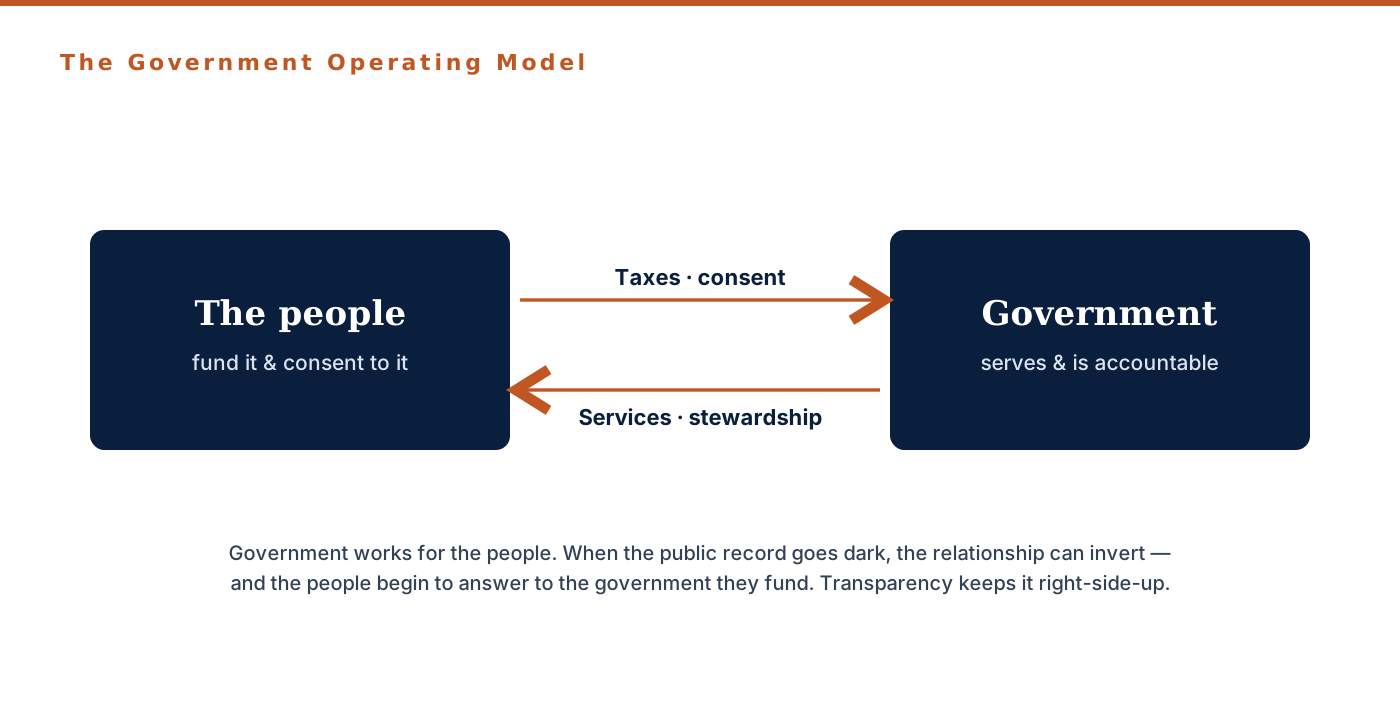
The productivity standard imposed on the citizen — through their employer, their client, their customer — must apply with equal force to the agencies that tax them. There is no constitutional carve-out for bureaucratic inefficiency.
— Guiding Principle IV, Local Government Accountability
Read the founding white paper: The Lag-Lead Trap →
Read our methodology: The Seven-Pillar Audit Framework →
Read our guiding principles: Our Beliefs →
Close the gap before it closes on you
Independent · No government money · No candidate money · Every finding sourced
- Published
- 27 May 2026
- Updated
- July 2026
Recommendations
What jurisdictions should do next
- 01Adopt a 36-month productivity parity plan with quarterly public milestones.
- 02Pilot AI document ingestion on the highest-volume citizen-facing workflows first.
- 03Redirect documented savings to service delivery before expanding administrative layers.
- 04Benchmark against the Fifty Cities Already inventory before claiming automation is impossible.
Efficiency Metrics
Parity means matching private-sector productivity growth rates over a defined window — measured by output per FTE and cost per transaction, disclosed annually.
Local Government Accountability — Policy Paper — May 2026