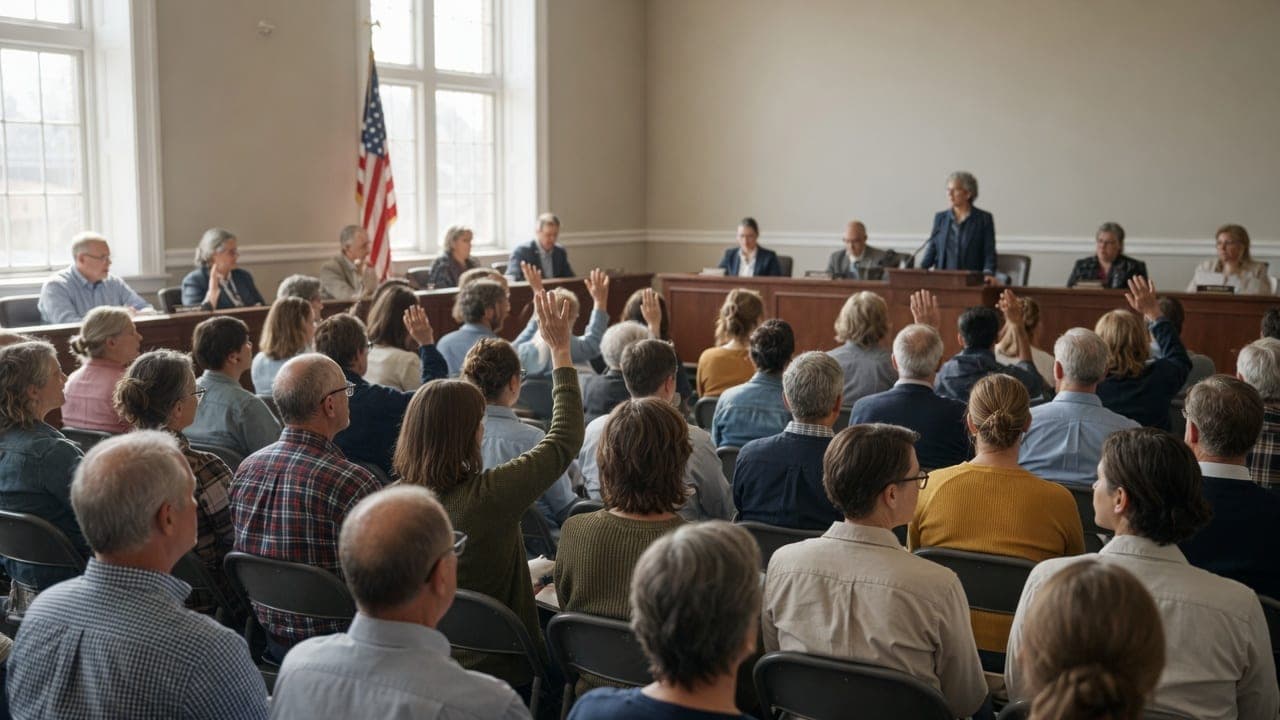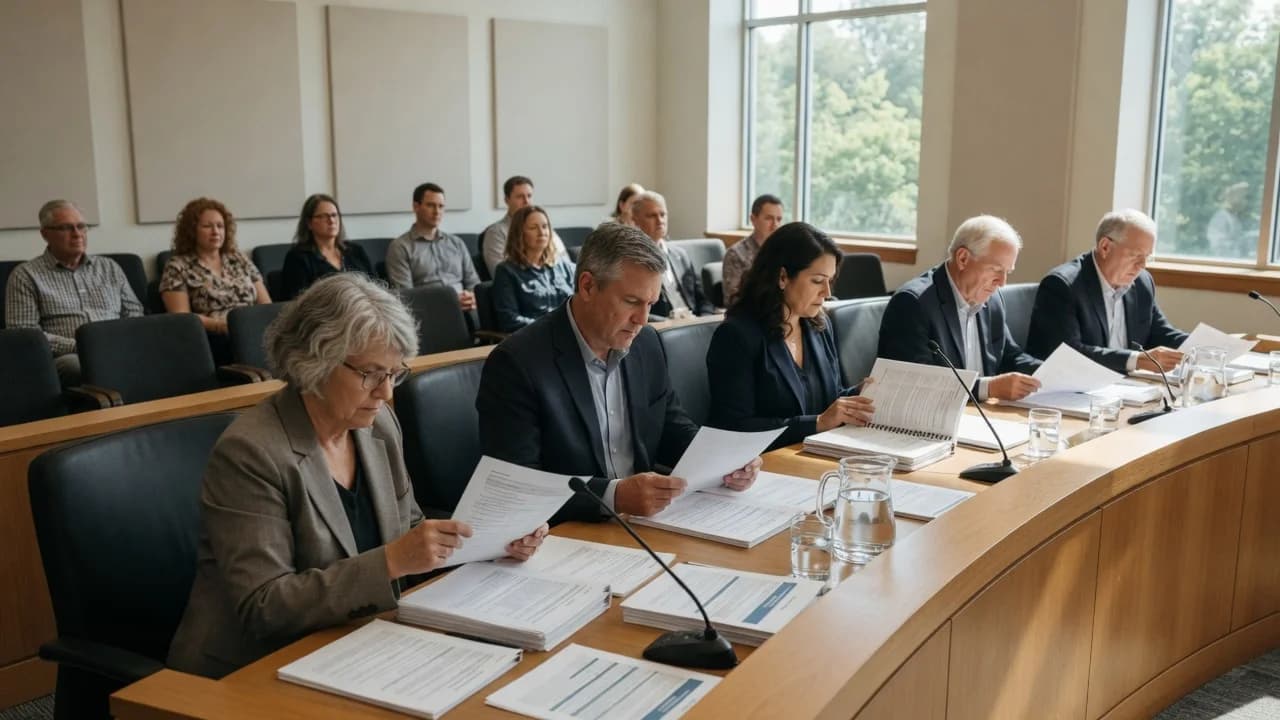
Magnifying glass over a government building — symbolizing public accountability

The records are public.
The accountability is missing.

LGAI delivers forensic analysis of local budgets, staffing, and debt — restoring the oversight once provided by local journalism.

Nonpartisan research for citizens who fund government.

THE PROBLEM

The accountability gap is no longer abstract.

A working family reviews bills and a property tax statement at their kitchen table at night.

They never asked you.

Your county raised the budget by half a billion dollars in a single year — no debate you were invited to, no reporter left in the room to ask why. Just the bill, landing on this table, in front of these kids.

LGAI reads every line they buried — and hands it back to you, in plain English, before the next vote.

Every federal scandal dominates cable news for weeks. Meanwhile, your county commission just approved a record budget with a three-paragraph summary in a weekly paper that has one reporter covering everything from school board meetings to zoning appeals. That is not an accident. It is a structural crisis — and it has a measurable price tag.

The decline of local news — over 3,200 local newspapers closed since 2005, and one in two U.S. counties now has no local news coverage.

The watchdog is dead in half of America.

Over 3,200 local newspapers have closed since 2005. One in two U.S. counties now has little or no local news coverage — and local government spending exploded the moment no one was left to report on it.

LGAI was built to take that watchdog post back — with records, math, and findings no official can spin.

3,200+

Local newspapers closed since 2005 — more than one-third of all U.S. local papers.

Source: Rebuild Local News

67%

Decline in reporters per $100 million of local government spending since 2005.

Source: Rebuild Local News

1 in 2

U.S. counties now have no — or minimal — local news coverage.

Source: Medill Local News Initiative

$2.5B

Sarasota County FY2026 budget — a single-year increase of $500 million, funding 4,151 full-time-equivalent positions. Almost no other Florida county is materially different.

Source: Sarasota County FY2026 Adopted Budget

The Team

A small outfit. A specific job. No ego.

We are not a think tank issuing reports no one reads. We are not a campaign consultancy picking winners. We are a specialist research institute — forensic accountants, data analysts, retired auditors, former public officials — engaged by citizens to do one thing: turn thousands of pages of public records into a report that ordinary people can use. Most of our researchers prefer to stay out of the spotlight. The work speaks; the names do not have to.

We Follow The Money.

We do not care who candidates slept with, divorced, or offended online. We care what they voted for, what they spent, what they owe, and what they hired. The facts live in budgets, bond disclosures, and meeting minutes — and that is where we work.

We Use Modern Tools.

Our research workflow applies the same class of rapid data-assimilation techniques now being adopted at federal and state levels — ingesting thousands of pages of public records in hours rather than months. Our tools are pencils, computers, and the public record.

We Work For Citizens.

We take tips from residents, neighborhood associations, watchdog groups, and local business owners. We do not work for candidates. We do not work for parties. If the facts embarrass someone, that is not our concern.

What We Believe

Stewardship, not scandal.

Government is a stewardship of other people's money. That is not a partisan statement — it is a structural fact. Every dollar your county commission spends, every bond your city issues, every contract your school board awards is a decision made on behalf of the taxpayers who funded it. The question is always the same: was it a prudent use of the public's money?

We think a lot of modern local government has drifted from that standard. Budgets grow with population growth regardless of whether the services need to. Bureaucratic staffing expands when modern technology should be enabling it to shrink. Economies of scale, which should reduce per-capita costs, are instead used to justify bigger departments, higher salaries, and more debt. That is not good stewardship. It is what happens when no one is counting.

We count. We publish the numbers. We trust that voters — Republican, Democrat, independent — can see a 2:1 compensation ratio between commissioners and the workers whose taxes pay them and draw their own conclusions.

When economies of scale and modern technology should be shrinking the cost of local government, and instead those savings are absorbed into bigger payrolls and more debt — that is not efficiency. That is a failure of stewardship. And it is happening in communities across the country right now.

— LGAI Research Methodology Brief, 2026

Three of our eight guiding principles:

I.Government Is the Servant, Not the Sovereign

Local government exists to perform a narrowly defined set of services. Anything beyond that core is a discretionary expansion that requires affirmative justification.

VI.Citizens Are the Ultimate Auditors

The Institute exists to equip the ordinary citizen with the data and analytical clarity necessary to exercise the franchise effectively.

VIII.The Stewardship Standard

Public servants administer funds taken under threat of legal compulsion. The standard of care owed to those funds is higher, not lower, than what a private fiduciary owes to a willing investor.

Read all 8 of our guiding principles →

Founding White Paper

The Lag-Lead Trap

Why local government must embrace the productivity revolution — or default on the public trust. Our founding analysis of the AI-driven productivity gap between the private sector and local government.

The Lag-Lead Gap — private sector productivity has risen sharply since 2000 while local government productivity has stayed nearly flat, a divergence of roughly 143 index points by 2023.

The private sector doubled its output. Government didn't move.

Since 2000, private-sector productivity has risen sharply while local government productivity stayed nearly flat. You paid for the difference — in higher taxes for the same service.

LGAI measures that gap in your community and publishes exactly what it costs you.

Read the white paper →

We are the institute concerned citizens call when the local paper is gone.

How LGAI works in three steps — citizens reach out, we investigate, we publish and citizens act.

This is how a community takes its government back.

A citizen submits a tip. Our researchers pull the budgets, contracts, and records. We publish the findings — and the people decide what happens next.

No party. No agenda. Just the public record, finally read out loud.

CURRENT WORK

Six communities. Four states. One accountability gap.

Our current investigation slate covers Louisville, Sarasota County, St. Petersburg, Hillsborough County, Frisco, and Denver. Each community was brought to us by citizens. Each has documented fiscal questions on a public record. Each has an upcoming election where the facts matter.

See All Investigations →

Is your local government the next investigation?

We cannot cover every town in America. We can cover the right ones — where citizens have spoken up, where public records tell a story, and where the cost of silence is real.