Case Study Compilation · 27 May 2026
Fifty Cities Already
A Working Inventory of Local-Government AI and Productivity Deployments Operating in 2025–2026
A Case Study Compilation from Local Government Accountability (LGAI)
Published 27 May 2026 — to be updated quarterly
Key Takeaways
- The argument that “no government can do this” is empirically false — more than fifty state and local governments already have — the roughly twenty local deployments documented below, the twenty-six states with formal AI initiatives, and the federal deployments they draw on.
- Documented case studies span permitting (Austin, Hamilton), financial operations (Winnipeg), citizen services (Liverpool), and workforce productivity (Pennsylvania, Utah).
- The operational savings are real, quantified, and disclosed by the governments themselves.
- The barrier to local adoption is political and bureaucratic — not technical, financial, or vendor availability.
- Every community can identify which case studies apply to its own structure and start with the smallest, lowest-risk pilots.
Reading time: 12 min
In This Edition
- New 2025–2026 municipal case studies
- Step-by-step implementation guide
- Peer-matching index for your jurisdiction
Interactive charts and a variable-input model are still in the works. This page is the current published edition; the PDF download is the printable version.
faster permit processing after Hamilton, Ontario's AI review pilot
NLC / Bloomberg Center for Cities
in annual savings from Liverpool's AI case management
Liverpool City Council
saved per worker per week in Pennsylvania's ChatGPT rollout
Commonwealth of Pennsylvania
Why This Document Exists
A consistent objection raised against the Productivity Parity Standard at local public meetings is that “no one is actually doing this in government.” The objection is empirically false, and the purpose of this document is to make that falsity demonstrable, sourced, and quarterly-updated. This is the working inventory of state and local governments that have already deployed AI and productivity tools at sufficient scale to produce measurable, publicly-disclosed results.
This is not a forecast. It is not a vendor white paper. It is not a sales document. It is a documented record of what has happened, attributable to specific governments, with specific tools, producing specific outcomes. Every entry below is sourced. Every entry is current as of the publication date of this document. LGAI commits to updating this compilation quarterly so that the inventory remains current.
The case studies are organized into six functional categories: permitting and land use, financial operations, citizen services and intake, public safety and health, workforce productivity tools, and statewide reform initiatives. Inside each category, jurisdictions are listed alphabetically, with the deployment, the vendor or platform (where disclosed), the reported outcome, and the source.
A summary of the headline figures is at the end of this document.
Category
Permitting and Land Use
Permitting is the dominant entry point for local-government AI deployment because (a) the workflow is high-volume and process-driven, (b) the records are typically already digital, (c) the user demand for faster review is intense, and (d) the savings are immediately measurable in time-to-permit.
Austin, Texas
Deployment: Archistar AI for development application review, launched September 2025.
Outcome: Site plan review time reduced from approximately one week to three to four minutes. The Director of Permitting publicly stated that the technology cuts “days, in some cases weeks” off site plan review.
Source: HousingWire reporting, November 2025.
Bellevue, Washington
Deployment: Govstream.ai partnership announced 2025.
Outcome: Active pilot in development permitting. Full rollout schedule not yet disclosed.
Source: HousingWire reporting, November 2025.
Hamilton, Ontario (Bloomberg Center for Cities partnership)
Deployment: AI scans first-stage building permit applications for compliance with city rules, building codes, and zoning requirements.
Outcome: Sixty percent decrease in permit processing time.
Source: National League of Cities case study, August 2025; Bloomberg Center for Cities publication.
Harris County, Texas
Deployment: AI for automated completeness screening of permits before staff review; initiated September 2025 with deployment in 2026.
Context: Permit volumes increased approximately twenty percent over three years while staffing remained flat — AI was selected as the mechanism to close the productivity gap without headcount expansion.
Source: Houston Public Media, November 2025.
Honolulu, Hawaii (City and County)
Deployment: Integrated residential permitting, inspections, enforcement, and land management with the city's online portal and mobile app.
Outcome: Unified citizen-facing service portal in operation.
Source: National League of Cities case study, July 2025.
Los Angeles, California (City Planning Department)
Deployment: AI analyzes land use regulations and zoning data to proactively identify issues during permit application review.
Outcome: Active deployment; staff cite earlier identification of compliance issues.
Source: National League of Cities case study, July 2025.
Seattle, Washington
Deployment: Mayor Bruce Harrell executive order, June 2025, directing all development applications to be reviewed through an AI pilot under a dedicated Permitting and Customer Trust team.
Outcome: Pilot in operation; full rollout expected in 2026.
Source: HousingWire reporting, November 2025.
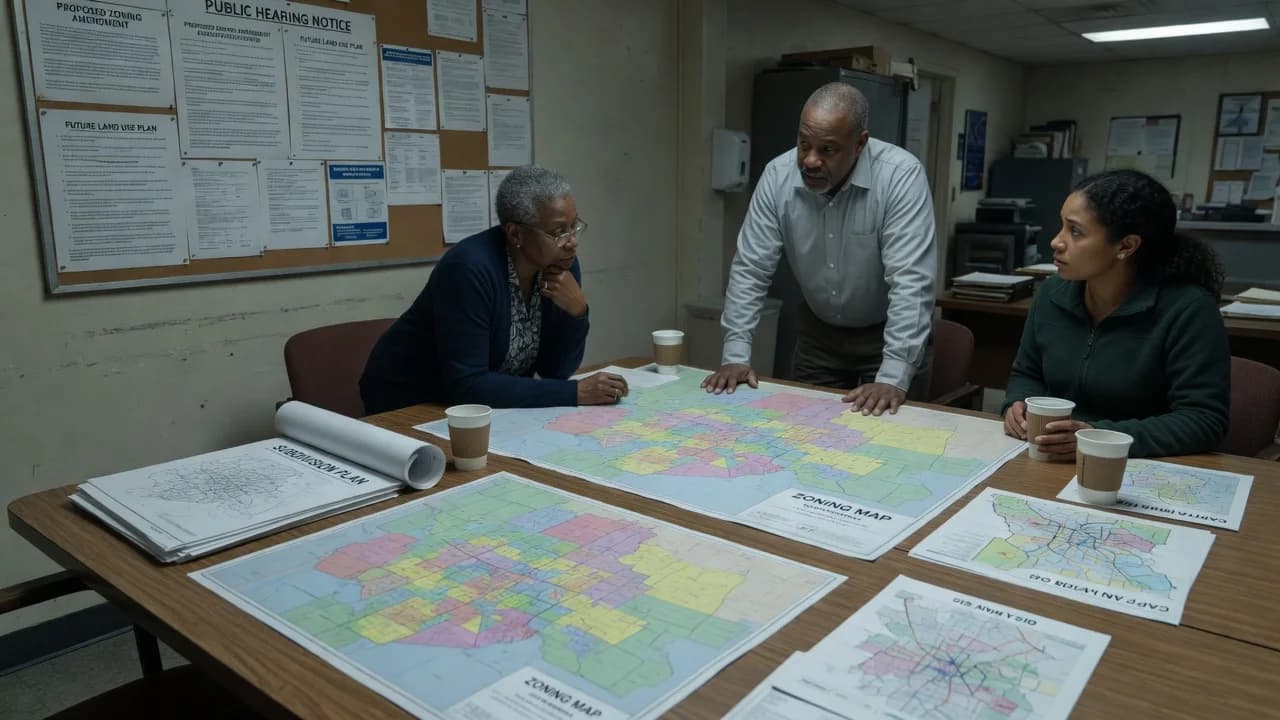
Category
Financial Operations
Financial operations — accounts payable, accounts receivable, financial reporting, audit support — are the second-most-common entry point for local-government AI deployment. The workflows are document-intensive, the data is already in financial systems, and the savings are quantifiable to the dollar.
Maryland Statewide Procurement (statewide initiative)
Deployment: Cross-agency procurement awareness, identifying underutilized statewide contracts that individual agencies were missing.
Outcome: A single insight on a single underutilized statewide shipping contract produced $800,000 in annual savings. The pattern scales to every recurring procurement category across all agencies.
Source: Maryland Modernization Initiative under Chief Performance Officer Asma Mirza, documented in NASCIO and federal grant award materials.
Winnipeg, Manitoba (City of Winnipeg)
Deployment: AI-powered invoice automation using optical character recognition with direct integration to the city's PeopleSoft financial system. Implementation in three phases through 2025–2026.
Outcome: Projected net-present-value savings exceeding $730,000 from a single workflow. Mayor Scott Gillingham publicly stated: “By cutting down on manual processing and reducing errors, we're saving money, speeding up payments, and freeing up staff time for more complex work.”
Source: City of Winnipeg official disclosure, May 2025.
Category
Citizen Services and Intake
Citizen-facing services — call centers, online inquiry handling, service request routing — are the third major category of local-government AI deployment. The savings here are typically expressed in staff time saved per case and in citizen satisfaction improvements rather than direct dollar amounts.
Estonia (Kratt Assistant — national program with municipal application)
Deployment: National-scale AI assistant handling citizen service requests across job recommendations, tax inquiries, and licensing.
Outcome: Substantial portion of total citizen service request volume handled without human intervention. Estonia is widely cited as the operational benchmark for AI-assisted government service delivery in a small-state context.
Source: National League of Cities and Bloomberg Center for Cities benchmark materials.
Liverpool City Council, England
Deployment: AI-powered case management system, Jadu partnership.
Outcome: Approximately £1.8 million in annual savings. Streamlined citizen services and reduced manual processing.
Source: SmartDev local-government AI use case compilation, October 2025.
Brazil (Multiple Municipal Waste Collection Programs)
Deployment: AI-driven municipal waste-collection routing and operations across major Brazilian cities.
Outcome: One hundred percent coverage in major cities; collection costs reduced by over forty-five percent.
Source: International benchmark cited in LGAI founding white paper.
Category
Public Safety and Health
Public safety and health deployments are the most operationally sensitive category because the consequences of error are immediate and visible. The current generation of deployments in this category is generally configured to assist human professionals rather than to replace them.
Johnson County, Kansas (NetSmart Bells AI for mental health documentation)
Deployment: AI-assisted clinical documentation for the county mental health team.
Outcome: Per-note documentation time reduced from approximately eighteen to eleven and a half minutes. Vendor case studies across the NetSmart platform report up to sixty-percent documentation reduction at scale, and approximately 5.2 hours per week saved per clinical worker.
Cost: $18,600 setup; $91,000 annual.
Payback: Less than one year for a mid-sized county human-services department.
Source: Johnson County Post and Nucamp government-AI training materials, August 2025.
Olathe, Kansas
Deployment: Municipal digitization and AI rollout under Granicus partnership, with county-level AI policy framework in development.
Outcome: Practical applications include dispatcher training assistance, prosecutor workflow tools, and budgeting support. The county's mental health team progress-note drafting time, as part of the NetSmart deployment, dropped from eighteen to eleven and a half minutes per note.
Source: Granicus digital transformation case study; Johnson County Post AI policy reporting.
Category
Workforce Productivity Tools (Government-Wide)
The fastest-spreading category of local- and state-government AI deployment is the rollout of general-purpose AI productivity tools — ChatGPT, Microsoft Copilot, Claude, Anthropic Claude Code, Google Gemini — to government staff for use across routine knowledge work. The savings in this category are reported in hours per worker per week, which scales powerfully when applied across thousands of FTEs.
Pennsylvania (Statewide ChatGPT Rollout)
Deployment: ChatGPT licensed for state staff use, rolled out 2024–2025.
Outcome: An average of eight hours per worker per week of time saved. Governor Josh Shapiro has publicly cited the figure as evidence of generative AI's operational value.
Implication: Eight hours per week on a forty-hour workweek is a twenty-percent productivity gain. Applied across a state workforce of approximately 75,000 employees, the cumulative annual hour savings is on the order of 30 million hours.
Source: StateScoop, December 2025.
Utah State Government (Claude Code Pilot)
Deployment: Anthropic Claude Code deployed across multiple Utah state agencies as part of the GRIT initiative.
Outcome: Christian Napier, Utah's Director of AI, publicly reported saving forty hours of developer work across a four-week period during the pilot.
Implication: A twenty-five-percent productivity gain on developer time at minimum, with broader gains expected as the deployment matures.
Source: GovTech, “An AI ‘Magic Moment’ Accelerates IT Development in Utah,” April 2026.
Federal General Services Administration (GSA USAi Platform)
Deployment: USAi — a FISMA Moderate AI tool with access to industry-leading models, a unified API framework, and a tracking console — available to federal, state, and local agencies through GSA procurement.
Significance: Establishes a secure, FISMA-compliant procurement pathway for AI tools that bypasses the security and procurement objections frequently raised at the local-government level.
Source: GSA official documentation.
Category
Statewide Reform Initiatives (the Framework Layer)
Statewide reform initiatives provide the policy framework, the executive authority, and the cross-agency coordination that make individual AI deployments politically and operationally sustainable. The leading state-level frameworks are summarized here; the deeper analysis is in the companion paper Productivity Parity.
Florida — Florida DOGE (Department of Government Efficiency)
Launch: July 21, 2025, by Governor Ron DeSantis and CFO Blaise Ingoglia.
Scope: Audits of local-government spending across all 67 Florida counties and 411 Florida municipalities.
Operational status by October 2025: Twelve jurisdictions audited in person, data requests dispatched to all 478 covered local governments.
Disclosed findings included: $75,000 Jacksonville mayoral hologram, $7.5 million Jacksonville one-mile sidewalk (eight times FDOT average), $1.9 million Jacksonville DEI arts grants, $150,000 annual Pensacola drag-show programming contract, $189,000 Gainesville Director of Equity salary, $460,000 Orlando tree inventory program.
State-level context: Florida maintains 96 full-time state employees per 10,000 residents — lowest in the U.S. Second consecutive year of year-over-year reduction in state spending.
Maryland — Modernization Initiative
Operational lead: Chief Performance Officer Asma Mirza.
Federal recognition: Maryland awarded two of seven federal AI grants distributed in late 2025 (45 states submitted over 400 applications).
Policy framework: Maryland Responsible AI Policy publicly available; all state AI procurement subject to defined intake process.
Significance: Maryland is the state-level operational benchmark for AI deployment under a published responsible-use framework.
Pennsylvania — ChatGPT Workforce Deployment
Operational lead: Governor Josh Shapiro.
Significance: Largest publicly-disclosed per-worker productivity benchmark currently available in U.S. state government.
South Carolina — DOGE Workforce Target
Position: South Carolina task force (predates the state's formal DOGE office) publicly argued in favor of replacing forty percent of public-sector employees with AI bots.
Significance: Represents the upper bound of the workforce-reduction target currently under public discussion at the state level. Included for completeness; LGAI does not endorse the figure as a target without operational verification.
Utah — GRIT (Government Reform, Innovation & Transparency)
Launch: May 9, 2025, by Governor Spencer Cox.
Scope: Statewide initiative requiring every state agency to (i) submit at least one efficiency improvement project to the Governor's Office of Planning and Budget annually, (ii) independently launch additional internal projects, (iii) participate in the EPIC (Efficiency and Process Improvement Collaborative) network, and (iv) report measurable results in cost savings, time savings, and improved service delivery.
Public feedback: Resident Customer Experience Initiative collects continuous feedback via QR codes on government receipts and in public buildings.
Reward structure: Agencies that implement evaluator recommendations can redirect a portion of the savings into staff retention.
State context: Utah ranks first in fiscal stability per U.S. News and World Report and first in economic outlook per ALEC States.
Virginia — Agentic AI Pilot
Launch: July 2025 executive order from then-Governor Glenn Youngkin.
Scope: Agentic AI tool to scan existing Virginia regulations and guidance against statute, flag conflicts, identify redundancies, and surface simplification opportunities.
Significance: Most operationally aggressive state-level agentic AI deployment currently documented in the public record.
Twenty-Six State Total (and counting)
According to the Economic Policy Institute, at least twenty-six states had launched their own version of a DOGE or DOGE-equivalent office by April 2025. LGAI treats this figure as a useful indicator of the political environment but notes that the operational rigor of these state-level offices varies dramatically. Utah's GRIT, Maryland's Modernization Initiative, and Virginia's agentic AI pilot are at the operational end of the spectrum. Some state offices have produced press releases without producing operational deliverables.
National Association of State Chief Information Officers (NASCIO) — The Institutional Benchmark
In December 2025, NASCIO published its 2026 Top 10 Priorities ranking, drawn from responses from 51 state and territory chief information officers. Artificial intelligence took the number-one spot for the first time, displacing cybersecurity, which had held the top position for the prior twelve consecutive years. Budget and cost control rose to number three. The 2026 NASCIO ranking is, in LGAI's view, the single most important institutional signal that the state government IT establishment has aligned on the productivity-reform thesis. The remaining question for local government is whether and how fast counties and municipalities will follow.
The Headline Numbers — A Summary Table
The figures below are the operationally credible benchmarks the LGAI cites in its work. Every figure is sourced; every figure is current as of this document's publication date.
Exhibit 1
Every headline number, with its source.
The operationally credible benchmarks LGAI cites, each figure current as of publication.
| Metric | Number | Source |
|---|---|---|
| Hamilton, ON permit processing time reduction | 60% | Bloomberg Center for Cities / NLC |
| Austin, TX site plan review time | 1 week → 3–4 minutes (~99%) | HousingWire |
| Liverpool annual citizen-services savings | £1.8M | SmartDev |
| Winnipeg NPV savings from invoice automation | $730K+ | City of Winnipeg |
| Johnson County KS per-note time reduction | 18 min → 11.5 min (36%) | Johnson County Post |
| NetSmart Bells AI scaled documentation reduction | up to 60% | Vendor case studies |
| NetSmart Bells AI per-clinician weekly hours saved | ~5.2 hours | Vendor case studies |
| Pennsylvania ChatGPT staff hours saved per worker per week | ~8 hours (20% productivity gain) | StateScoop |
| Utah Claude Code developer hours saved over 4 weeks | 40 hours | GovTech |
| Maryland cross-agency procurement savings (single insight) | $800K annual | NASCIO |
| Brazil municipal waste cost reduction | 45%+ | International benchmark |
| Florida state workers per 10,000 residents | 96 (lowest in U.S.) | Florida Governor’s Office |
| Federal civilian workforce reduction Jan–Nov 2025 | ~9% (~271K workers) | Cato Institute / OPM |
| NASCIO 2026 priority for AI | #1 (first time in 13 years) | NASCIO |
| Gartner forecast — orgs eliminating ≥50% middle management by end of 2026 | 20% (1 in 5) | Gartner |
| PwC — AI economic value captured by top-tier adopters | 74% by 20% of orgs | PwC 2026 Performance Study |
| South Carolina task force workforce replacement target | up to 40% | EPI / SC Task Force |
| States that have launched DOGE-equivalent offices | ≥26 | Economic Policy Institute |
What This Means for Sarasota County and Its Peers
The case studies above are not theoretical. They are operating today, in real local governments, producing measurable results that elected officials and administrators in those jurisdictions have endorsed in writing.
Sarasota County's FY2026 budget is $2.5 billion, funding 4,151 FTEs. The Sarasota County savings exercise that the County Administrator asked all departments to undertake produced $2.2 million in cumulative reductions — less than one-tenth of one percent of the budget. By contrast, Pennsylvania's ChatGPT rollout produces approximately twenty-percent productivity gain per worker; Hamilton, Ontario, produces sixty-percent permit-time reduction; Austin produces ninety-nine-percent site-plan review reduction; Winnipeg's single workflow produces $730,000 in net present value savings.
Sarasota County has not, as of the date of this document's publication, commissioned a comparable operational audit. Neither has Hillsborough County, St. Petersburg, Tampa, Bradenton, Cape Coral, Naples, Fort Myers, Lakeland, or any other Florida county or municipality outside the statewide audit reach of Florida DOGE. LGAI's view is that this is the structural failure that the next budget cycle must address — not by adopting any single one of the case studies above as a model, but by undertaking the operational audit that determines which of them, and which combination of them, would deliver the most value in each specific Florida community.
Among the communities LGAI is documenting under this expectation is Sarasota County. The questionnaire issued to candidates for the August 18, 2026, Republican primary explicitly asks each candidate whether they support commissioning a seven-pillar operational audit of city administration within the first year of office, and what their target savings rate would be over four years. The answers will be published verbatim by July 1, 2026.
Methodological Notes
This is a working inventory. It is not exhaustive. This inventory is expanded quarterly; the August 2026 update will add newly documented deployments. Several factors limit current coverage:
- Smaller-municipality deployments that have not received trade-press coverage are likely underrepresented.
- Pilot programs that have not yet produced reportable outcomes are excluded.
- Vendor-marketed case studies that lack independent verification are excluded.
- Deployments by federal agencies are largely excluded except where they materially affect state and local procurement options (GSA USAi).
- International benchmarks (Brazil, Estonia, U.K.) are included for context but are not the primary focus of this compilation.
LGAI commits to expanding coverage in each quarterly update. Specific gaps LGAI is working to fill include:
- Florida-specific deployments outside the statewide audit reach of Florida DOGE. LGAI would welcome documented examples for inclusion in the next update.
- County-level (versus state-level) productivity deployments in the U.S. Mountain West.
- Mid-sized city deployments (population 50,000–150,000) where the operational case is most directly applicable to LGAI's investigation slate.
Citizens, journalists, and local-government staff are invited to submit documented deployments for inclusion at the contact addresses published on LGAI's website. Standard editorial verification applies: every entry requires a documented source, a quantified outcome, and the name of the deploying jurisdiction.
Conclusion
The objection that “no one is doing this in government” is, in 2026, false. The list above is the demonstration. LGAI will continue updating it as the deployments accumulate. The relevant question for Sarasota County, for Hillsborough County, for St. Petersburg, for Tampa, and for every other Florida and U.S. local government is not whether to begin — it is how long they intend to wait before they do.
The barrier to local-government adoption is not technology, capital, or vendor availability. The barrier is the political and bureaucratic incentive structure, which currently rewards growth and punishes contraction.
— The Lag-Lead Trap, founding white paper of Local Government Accountability
Read the founding white paper: The Lag-Lead Trap →
Read our methodology: The Seven-Pillar Audit Framework →
Read the productivity standard: Productivity Parity →
Read our guiding principles: Our Beliefs →
The question is not whether — it is how long you'll wait
Independent · No government money · No candidate money · Every finding sourced
- Published
- 27 May 2026
- Updated
- June 2026
Recommendations
What jurisdictions should do next
- 01Identify the three case studies closest to your jurisdiction's structure and replicate the smallest pilot first.
- 02Disclose vendor contracts, savings assumptions, and FTE impacts before full deployment.
- 03Publish before/after metrics for any automation program within 90 days of launch.
- 04Treat political resistance as a governance problem — the technology is already proven.
Efficiency Metrics
Documented deployments cite government-published savings and cycle-time improvements — LGAI does not extrapolate vendor marketing claims into jurisdiction-specific guarantees.
Local Government Accountability — Case Study Compilation — May 2026
Next quarterly update: August 2026